

A Brief History of the Scarf
THE HISTORY OF SCARVES — 3 MIN READ
A Brief History
of the Scarf
From a cloth carried in the hand to a patterned silk square, the scarf has more than one history. Here are a few documented moments in that wider story.
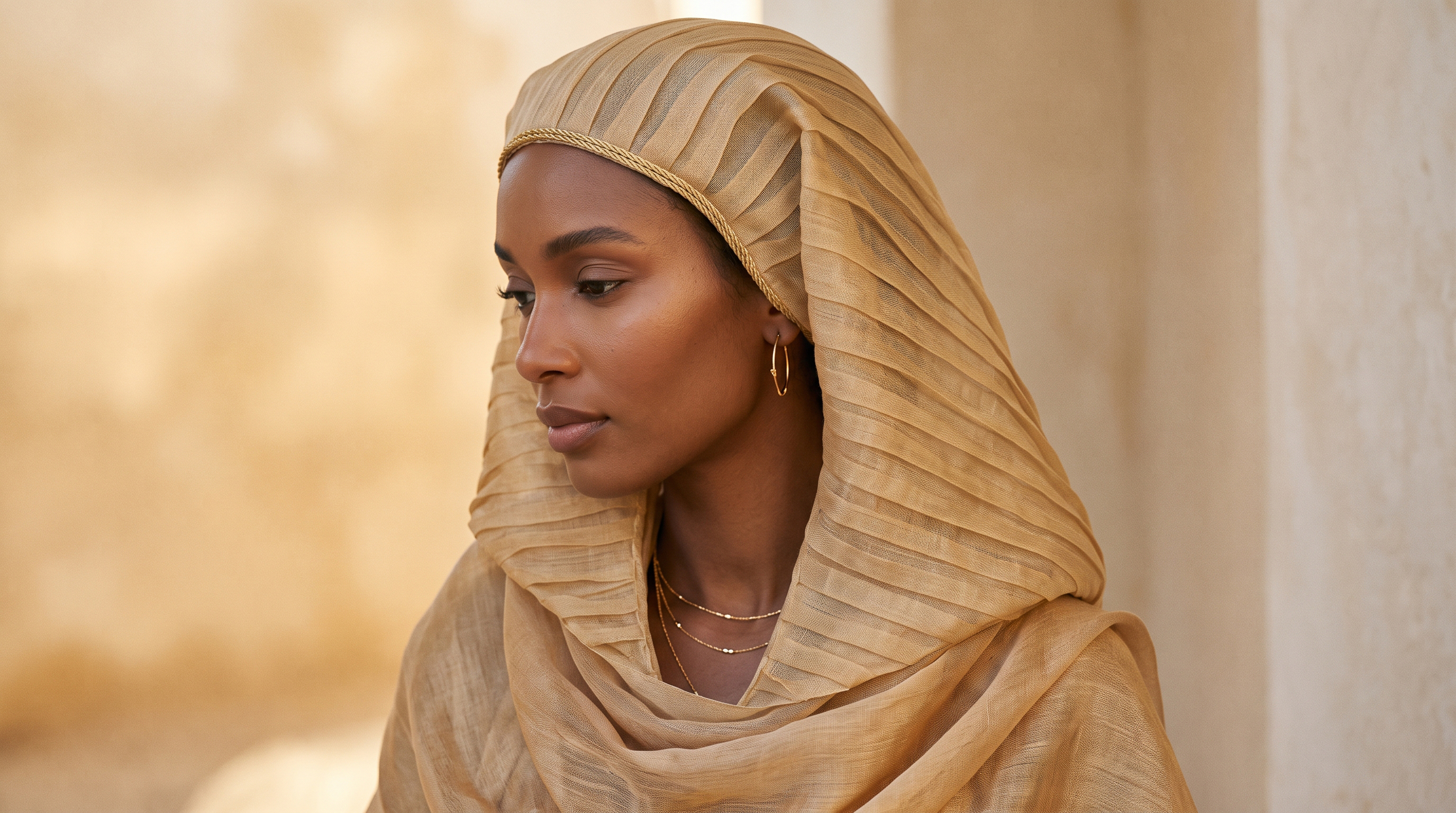
Image note: the images accompanying this article are contemporary illustrations, not historical evidence or verified reconstructions of ancient dress.
More than one beginning
When did the scarf first appear? The sources gathered here do not establish a single date or inventor. A handkerchief, a head covering, a cravat and a shawl are different objects. Their histories offer useful context, but they should not be treated as interchangeable names for the modern scarf.
Ancient cloth, not a first scarf
A remarkably fine linen sheet in The Metropolitan Museum of Art dates to around 1491–1473 BCE. Found in the tomb of Hatnefer and Ramose in Egypt, it preserves evidence of skilled weaving, repair and laundering. It tells us about the value and care of cloth, not the invention of the scarf. [1]
In Latin, sudarium refers to a cloth used to wipe away perspiration — a handkerchief. Lewis and Short cite ancient authors including Catullus and Quintilian. This gives us evidence of a practical cloth in Roman life, but not proof that it was the direct ancestor of today's neck scarf. [2]
Cloth at the neck
By the seventeenth century, the cravat provides a clearer example of cloth worn at the neck in European dress. A print of Charles II dated around 1660 in the Royal Collection depicts him wearing a plain cravat. It is a documented moment in the history of neckwear, rather than a date for the invention of all scarves. [3]
Shawls, silk and changing fashions
Kashmir shawls were part of dress at the Mughal court and became fashionable in Europe by the late eighteenth century. Their European popularity peaked in the first half of the nineteenth century. These larger wraps have their own history, connected to trade, craftsmanship and changing ways of dressing. [4]
For the silk scarf itself, surviving objects give us a concrete reference: The Met holds a British silk scarf dated 1800–1810. It is an example we can date, not a claim to the first scarf ever made. [5]
The printed silk square
In the twentieth century, the printed silk square became an important format for fashion design. One documented milestone is Hermès' first silk scarf in 1937, Jeu des omnibus et dames blanches. That date marks the beginning of the house's scarf collection, not the invention of the silk scarf. [6]
A detail made personal
For us, the interest lies in what a simple piece of fabric allows: it can be folded, tied or draped, revealing a different part of its design each time. History provides the context; the person wearing it decides what comes next.
A small piece of cloth.
Many ways to make it your own.
Sources & further reading
[1] The Metropolitan Museum of Art, Length of Very Sheer Linen Cloth.
[2] Lewis & Short, A Latin Dictionary, “sudarium”, via the Berlin-Brandenburg Academy of Sciences and Humanities.
[3] Royal Collection Trust, Charles II with the Royal Oak.
[4] The Metropolitan Museum of Art, Shawl, Kashmir, nineteenth century.
[5] The Metropolitan Museum of Art, Scarf, British, 1800–1810.
[6] Hermès, Six generations of artisans.